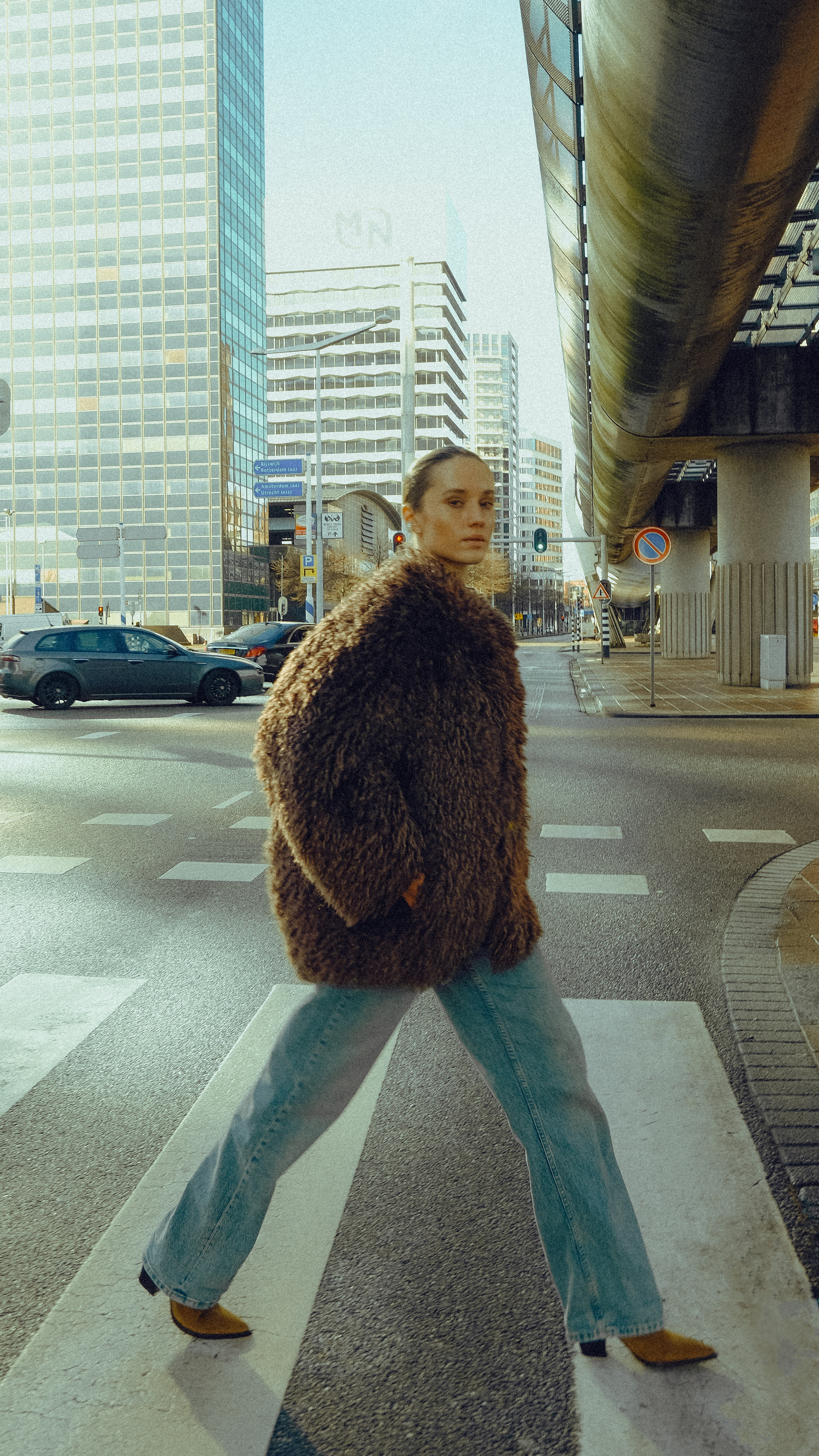
Why Fuji?
My Canon R6 is the base. A reliable, predictable tool that I know down to the last click. But sometimes I just want to go out of the house light, not feeling like a photographer at work, but also not limiting myself to the capabilities of the iPhone. That's when Fujifilm X-T30 III appeared in my bag.
I had been looking at the hype-filled X100VI, but the idea of a fixed lens quickly turned me off. I value freedom: today I want to shoot at 23mm (this is the equivalent of my favorite 35mm on full frame), but tomorrow I might need zoom. In the end, the choice fell on the X-T30 III. She seduced me with her «mechanical» design, compactness and built-in flash - very useful in street photography for creating that sharp, «newspaper» frame.
Baptism by fire
This camera saved me before I could even get familiar with it properly. At one of the recent weddings, something happened that hadn’t occurred throughout my entire practice: all batteries in both the main R6 and the spare 6D discharged at once right at the end of a walk. Relatives were in line for photos, everyone was waiting... I had to take out the Fuji.
Of course, the XC 13-33mm is not the optics I'm used to, but in the reportage flow the camera performed reliably. This was the moment when I realized: it's not just a «toy for the soul», but a reliable backup that won't let you down in a critical situation.
Challenges of translation (and control)
Switching from Canon's ergonomics to Fuji's logic is a separate quest. I'm not one of those who reads instructions, so my first few hours with the camera were full of surprises:
Where is the video?! I seriously looked for the record button for about an hour. It turned out to be hidden in the Drive mode - not the most obvious logic for someone accustomed to a separate button with a red dot.
Battle with disks. There's no aperture ring on the kit lens, and I couldn't figure out how to quickly change exposure for a long time. Had to go into the settings (
Button/Dial Setting) and setAperture SettinginManualmode, so that the front dial on the body finally started controlling the aperture.RAW files. My usual Lightroom simply refused to open them. I had to update all the software to the latest versions just to see the results of my work.
The aesthetics of the 70s and the 'smart soapbox'
The main reason for all this effort - it's color. I have always been close to the aesthetics of the 70s, and now when the style of the 80s and 90s is in fashion, Fuji perfectly fits into this mood. Modes Film Simulation allow you to achieve the effect of a 'quality soapbox' directly from the camera. The frame looks alive, with character, and you don't want to torture it with long processing. By the way, these modes are only available when shooting in jpeg, so you won't be able to get more out of Lightroom.
The truth is, I miss Canon's capabilities in portraits a lot. I still can't get the same depth and 'expensive' skin tone that I'm used to with the R6 from Fuji. In terms of dynamic range, the new model also loses. In street photography, the JPG image flies in with a bang, but for commercial portraits in complex conditions Canon is still unmatched.
What's the result?
Has the X-T30 III become a camera for everyday use? Not yet. If I need to quickly catch a frame at home, I still pull out my iPhone. But for creative walks, street photography, and future trips - it's the perfect companion.
It gives that artistic touch and slight depth of field that smartphones don't have, but at the same time allows you to remain unobtrusive and shoot 'from the hip'. And not carry a heavy photo backpack. It's not a replacement for my main system, it's a different perspective on the process - lighter, bolder, and freer.
Few first shots with my new camera could be found in the gallery below: